Be yourself; Everyone else is already taken.
— Oscar Wilde.
This is the first post on my new blog. I’m just getting this new blog going, so stay tuned for more. Subscribe below to get notified when I post new updates.
Be yourself; Everyone else is already taken.
— Oscar Wilde.
This is the first post on my new blog. I’m just getting this new blog going, so stay tuned for more. Subscribe below to get notified when I post new updates.

Literacy 320
Fiction Book Choices
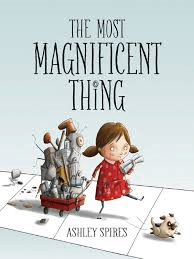
Spires, A. (2014). The most magnificent thing. Toronto, Canada: Kids can Press.
Summary taken from Amazon : Award-winning author and illustrator Ashley Spires has created a charming picture book about an unnamed girl and her very best friend, who happens to be a dog. The girl has a wonderful idea. “She is going to make the most MAGNIFICENT thing! She knows just how it will look. She knows just how it will work. All she has to do is make it, and she makes things all the time. Easy-peasy!” But making her magnificent thing is anything but easy, and the girl tries and fails, repeatedly. Eventually, the girl gets really, really mad. She is so mad, in fact, that she quits. But after her dog convinces her to take a walk, she comes back to her project with renewed enthusiasm and manages to get it just right. For the early grades’ exploration of character education, this funny book offers a perfect example of the rewards of perseverance and creativity. The girl’s frustration and anger are vividly depicted in the detailed art, and the story offers good options for dealing honestly with these feelings, while at the same time reassuring children that it’s okay to make mistakes. The clever use of verbs in groups of threes is both fun and functional, offering opportunities for wonderful vocabulary enrichment. The girl doesn’t just “make” her magnificent thing — she “tinkers and hammers and measures,” she “smoothes and wrenches and fiddles,” she “twists and tweaks and fastens.”
Grade Level: Preschool- 2nd Grade
Justification: I think this book is a great book to be used in the classroom. Not only does this book show students that it is okay to make mistakes but also that you should never give up on your dreams. I think sometimes in the classroom students lose the appeal to their education, meaning that they cant see the end product. This book also has an educational aspect to it as well this can be beneficial for students in the science and engineering field. through the standard ETS1.A: Defining Engineering problems – A situation that people want to change or create can be approached as a problem to be solved through engineering. Such problems may have acceptable solutions. This story would be perfect to help model this.
Review: “Making things is difficult work. Readers will recognize the stages of this young heroine’s experience as she struggles to realize her vision. First comes anticipation. The artist/engineer is spotted jauntily pulling a wagonload of junkyard treasures. Accompanied by her trusty canine companion, she begins drawing plans and building an assemblage. The narration has a breezy tone: “[S]he makes things all the time. Easy-peasy!” The colorful caricatures and creations contrast with the digital black outlines on a white background that depict an urban neighborhood. Intermittent blue-gray panels break up the white expanses on selected pages showing sequential actions. When the first piece doesn’t turn out as desired, the protagonist tries again, hoping to achieve magnificence. A model of persistence, she tries many adjustments; the vocabulary alone offers constructive behaviors: she “tinkers,” “wrenches,” “fiddles,” “examines,” “stares” and “tweaks.” Such hard work, however, combines with disappointing results, eventually leading to frustration, anger and injury. Explosive emotions are followed by defeat, portrayed with a small font and scaled-down figures. When the dog, whose expressions have humorously mirrored his owner’s through each phase, retrieves his leash, the resulting stroll serves them well. A fresh perspective brings renewed enthusiasm and—spoiler alert—a most magnificent scooter sidecar for a loyal assistant. Spires’ understanding of the fragility and power of the artistic impulse mixes with expert pacing and subtle characterization for maximum delight.” As cited from Kirkus Reviews : https://www.kirkusreviews.com/book-reviews/ashley-spires/the-most-magnificent-thing/
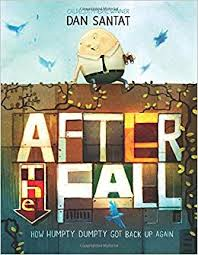
Santat, D. (2017). After the fall: how Humpty Dumpty got back up again . New york , NY: Roaring Book Press.
Summary: Everyone knows that when Humpty Dumpty sat on a wall, Humpty Dumpty had a great fall. But what happened after? Caldecott Medalist Dan Santat’s poignant tale follows Humpty Dumpty, an avid bird watcher whose favorite place to be is high up on the city wall―that is, until after his famous fall. Now terrified of heights, Humpty can longer do many of the things he loves most. Will he summon the courage to face his fear?
Age Level: Preschool- 3rd Grade
Justification: I actually used this book in the classroom this semester, I though this book had such a great lesson that students could gain from. A standard that would fit nicely with this book would be RL.1.2- With prompting and support, recognize key details from a summary to demonstrate understanding of the author’s message, lesson learned, and/or moral. Like I said previously this story has a great lesson learned and students seemed to thoroughly enjoy this book which is why I chose it. With little help students could figure out the moral of the story which makes it a good option when teaching this standard.
Review: ” An avid ornithophile, Humpty had loved being atop a high wall to be close to the birds, but after his fall and reassembly by the king’s men, high places—even his lofted bed—become intolerable. As he puts it, “There were some parts that couldn’t be healed with bandages and glue.” Although fear bars Humpty from many of his passions, it is the birds he misses the most, and he painstakingly builds (after several papercut-punctuated attempts) a beautiful paper plane to fly among them. But when the plane lands on the very wall Humpty has so doggedly been avoiding, he faces the choice of continuing to follow his fear or to break free of it, which he does, going from cracked egg to powerful flight in a sequence of stunning spreads. Santat applies his considerable talent for intertwining visual and textual, whimsy and gravity to his consideration of trauma and the oft-overlooked importance of self-determined recovery. While this newest addition to Santat’s successes will inevitably (and deservedly) be lauded, younger readers may not notice the de-emphasis of an equally important part of recovery: that it is not compulsory—it is OK not to be OK.” Retrieved from Kirkus Reviews: https://www.kirkusreviews.com/book-reviews/dan-santat/after-the-fall-how-humpty-dumpty-got-back-up-again/
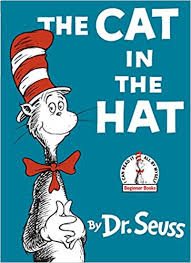
Seuss, D. (1957). The cat in the hat. New York: Random House.
Summary: Poor Dick and Sally. It’s cold and wet and they’re stuck in the house with nothing to do . . . until a giant cat in a hat shows up, transforming the dull day into a madcap adventure and almost wrecking the place in the process! Written by Dr. Seuss in 1957 in response to the concern that “pallid primers [with] abnormally courteous, unnaturally clean boys and girls’ were leading to growing illiteracy among children, The Cat in the Hat (the first Random House Beginner Book) changed the way our children learn how to read.
Retrieved from amazon: https://www.amazon.com/Cat-Hat-Dr-Seuss/dp/039480001X/ref=sr_1_1?crid=3MLJZ0T8DPQQO&keywords=the+cat+in+the+hat&qid=1575339867&s=books&sprefix=the+cat+in+the+%2Cstripbooks%2C236&sr=1-1
Age level: Preschool-2nd grade
Justification: This book is a classic. Most students can recognize this book, and generally they enjoy it too. This is a good book to use with the standard RL.2.4-describe how words and phrases, including but not limited to regular beats, alliteration, rhymes and/or repeated lines, supply rhythm and shape meaning in the story, poem, or song. Most children already know that most of Dr. Seuss uses quite a bit of rhyming and repeated lines which makes this story a perfect fit for the standard. This book would also keep students engaged and could have a lot of fun activities to pair with the lesson. After reading the students could even watch part of the cat in the hat cartoon to tie in with the lesson.
Review: ” A reissue of the earlier Houghton, Mifflin educational edition, brought out specifically as a text for beginning readers, brings back the story of that rainy day at home when the Cat in the Hat arrived to upset things and put them back in order again. It is a perfect sublimation of what can happen and the Seuss drawings tell as much of a story as his simple verses. Back sewn” As cited from Kirkus Reviews: https://www.kirkusreviews.com/book-reviews/dr-seuss-2/the-cat-in-the-hat/
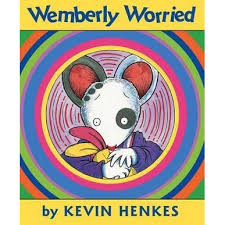
Henkes, Kevin. (2000). Wemberly worried. New York :Greenwillow Books.
Summary: Wemberly worried about spilling her juice, about shrinking in the bathtub, even about snakes in the radiator. She worried morning, noon, and night. “Worry, worry, worry,” her family said. “Too much worry.” And Wemberly worried about one thing most of all: her first day of school. But when she meets a fellow worrywart in her class, Wemberly realizes that school is too much fun to waste time worrying!
Retreived from Amazon: https://www.amazon.com/Wemberly-Worried-Kevin-Henkes/dp/0061857769/ref=sr_1_1?crid=2AX9U23MYJANI&keywords=wemberly+worried&qid=1575340303&s=books&sprefix=wemberl%2Cstripbooks%2C188&sr=1-1
Age Level: Preschool-4th Grade
Justification: this book is a great book to help students identify how character’s are feeling. This book would work with the standard RL.1.4- Identify words and phrases in stories or poems that suggest feelings or appeal to the senses in order to contribute meaning. I think students could relate with this book because most students do feel worrisome about starting school. Although, the person that I used that reviewed this story seemed to think that it is unbelievable as well as unrealistic, I would like to point out that they are an adult. Children read stories from a very different view than adults do. So that is why I stand with my choice of this story, not only do I think that children will be able to relate to it but they also can sympathize with Wemberly.
Reviews: ” Henkes’s best works—Chrysanthemum (1991) and Lily’s Purple Plastic Purse (1996), among others—are masterpieces, capturing and distilling the essence of universal childhood experiences. Unfortunately, Wemberly Worried doesn’t fall into this category. It’s hard to buy that her personality could undergo so radical a change just because she finds a new friend. Surely a new friendship would bring with it a whole new set of worries. The reader actually feels sorry for Wemberly, who doesn’t seem to be enjoying life very much. Maybe some mouse therapy is called for. ” As cited from Kirkus reviews: https://www.kirkusreviews.com/book-reviews/kevin-henkes/wemberly-worried/
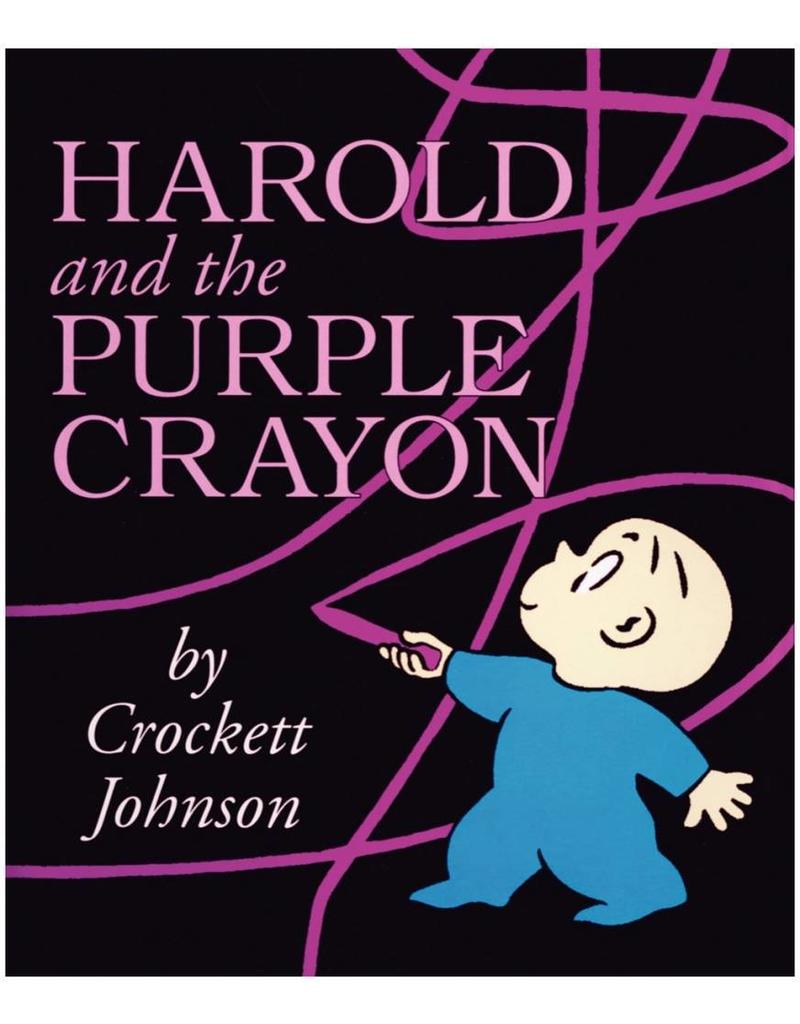
Johnson, C. (1955). Harold and the Purple Crayon. New York: Random House.
Summary: One evening Harold decides to go for a walk in the moonlight. Armed only with an oversize purple crayon, young Harold draws himself a landscape full of wonder and excitement. Harold and his trusty crayon travel through woods and across seas and past dragons before returning to bed, safe and sound. Full of funny twists and surprises, this charming story shows just how far your imagination can take you.
Retrieved from Amazon: https://www.amazon.com/Harold-Purple-Crayon-Books/dp/0064430227/ref=sr_1_1?crid=2LS4MNW9IBPL6&keywords=harold+and+the+purple+crayon&qid=1575341880&s=books&sprefix=Harold+and%2Cstripbooks%2C283&sr=1-1
Age Level: Preschool-3rd Grade
Justification: I remember having this story read to me when I was little. I also remember having a strong urge to start drawing after having this read to me. RL.K7- With prompting and support, describe the relationship between illustrations and the story in which they appear. this is a good story to use with the standard because how the graphics that go along with this story. It is a good choice to describe the relationship between the illustrations and the text. I think this is also a good story to inspire student creativity.
Review: ” A clever little volume and pint sized- like Harold- contains the story of how he drew himself all over the place one evening with his purple crayon. Deciding to go for a walk in the moonlight, Harold draws a moon, then a path, and starts off. Then by mistake there’s an ocean, a city, and more, until Harold wants his own window again and finally hits on drawing it around the moon. Johnson’s picture are purple. You’ll laugh at this. Good stitches.” As cited from Kirkus Reviews: https://www.kirkusreviews.com/book-reviews/crockett-johnson/harold-and-the-purple-crayon/
Informational Books
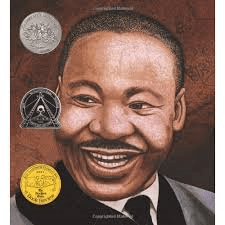
Rappaport, D. (2001). Martin’s Big words: The life of Dr. Martin Luther King Jr. New York: Hyperion Books for Children.
Summary: This picture-book biography is an excellent and accessible introduction for young readers to learn about one of the world’s most influential leaders, Dr. Martin Luther King, Jr. Doreen Rappaport weaves the immortal words of Dr. King into a captivating narrative to tell the story of his life. With stunning art by acclaimed illustrator Bryan Collier, Martin’s Big Words is an unforgettable portrait of a man whose dream changed America-and the world-forever. Retrieved from Amazon: https://www.amazon.com/Martins-Big-Words-Martin-Luther/dp/1423106350/ref=sr_1_1?crid=2L5MX3SYTLH27&keywords=martins+big+words+the+life+of+dr+martin+luther+king+jr&qid=1575413805&sprefix=Martins+big+%2Caps%2C142&sr=8-1
Age Level: 5-10 years old
Justification: Most student can identify who MLK was so I think this is a good story to give them some more information on him as a person. A standard that fits well with this book is RL.3.3- Describe how characters in a story, including but not limited to their traits, motivations, actions, or feelings, and how they affected the plot. This book is not only a nice little history lesson for students but it also shows students a problem and a solution in a positive aspect. Many different activities can be used with this book, one could be students writing their own “I have a dream” speech. I think this book could inspire students which is why I chose it.
Review: “It’s an homage in words and pictures, in which the author weaves King’s words with her own to present a brief but stately portrait of the American hero. Rappaport explains that as a child King was determined to use “big words,” no doubt the result of listening to his father preach. On many subsequent spreads, King is pictured as an adult, and a direct quote is reproduced in bold type. In fact, King’s words were huge in idealism, delivering a message that was big in simple yet profound ways that can be understood by young readers. In smaller print, Rappaport gives historical context. Her sentences have a directness and symmetry that sets off King’s more transcendent, poetic quotes. Collier’s watercolor and cut-paper-collage illustrations express deep feeling. On the cover and final two portraits, King is depicted with a subtle monochromatic technique, which alludes strongly to a stained-glass metaphor, represented in portraits of King’s church. In other spreads featuring King himself, his face is lit, giving it a powerful visual weight and compelling readers to pay attention. While the cover portrait shows his eyes glancing to the side, in the final portrait he looks directly at the reader, his eyes offering an unmistakable challenge. Author and Illustrator Notes are moving as well as informative, and quotes are attributed. Readers will hear his voice echo in this presentation.” As stated from Kirkus Reviews: https://www.kirkusreviews.com/book-reviews/doreen-rappaport/martins-big-words/
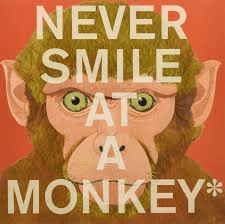
Jenkins, S. (2009). Never smile at a monkey: And 17 other important things to remember. Boston, Massachusetts: Houghton Mifflin Harcourt.
Summary: When it comes to wild animals, everyone knows that there are certain things you just don’t do. It’s clearly a bad idea to tease a tiger, pull a python’s tail, or bother a black widow spider. But do you know how dangerous it can be to pet a platypus, collect a cone shell, or touch a tang fish? Some creatures have developed unusual ways of protecting themselves or catching prey, and this can make them unexpectedly hazardous to your health. In this dynamic and fascinating picture book by Steve Jenkins, you’ll find out what you should never do if you encounter one of these surprisingly dangerous animals. Retrieved from amazon: https://www.amazon.com/Never-Smile-Monkey-Important-Remember-ebook/dp/B003X09YKG
Age level: 4-7 Years old
Justification: LS1.A: Structure and Function- All organisms have external parts. Different animals use their body parts in different ways to see, hear, grasp objects, protect themselves, move from place to place, and seek, find, and take in food, water and air. This standard ties in with this story nicely because it helps teaches students why animals might behave a certain way. Generally, when an animal acts out is because they are trying to protect themselves or they view the other person as prey or a threat. Students will learn about how the animals in the story use their external parts to protect themselves which fits the standard perfectly. I also add this book because I remember it being read to me in the classroom and I found it engaging then.
Review: ” Eighteen alliterative rules showcase the dangerous defense mechanisms of animals found in the wild. Jenkins warns readers to “never pet a platypus,” “never harass a hippopotamus” and, true to the title, “never smile at a monkey”—a Rhesus monkey to be precise. Baring teeth can be seen as an aggressive gesture and the monkey may attack. Illustrated with the author’s trademark ingenious paper collage, the animals look serene and unassuming, as is often the case in nature. But turn to the detailed endnotes, and jaws and claws are out with a vengeance. Another stunning environmental lesson from an aficionado of animal behavior.” As stated from Kirkus Reviews: https://www.kirkusreviews.com/book-reviews/steve-jenkins/never-smile-at-a-monkey/
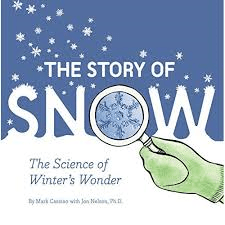
Cassino, M. (2011). The story of snow: the science of winter’s wonder. San Francisco, California: Chronicle Books.
Summary: How do snow crystals form? What shapes can they take? Are no two snow crystals alike? These questions and more are answered in this visually stunning exploration of the science of snow. Perfect for reading on winter days, the book features photos of real snow crystals in their beautiful diversity. Snowflake-catching instructions are also included. Retrieved from Amazon: https://www.amazon.com/Story-Snow-Science-Winters-Wonder-ebook/dp/B00651973E/ref=sr_1_1?keywords=the+story+of+snow&qid=1575414799&s=digital-text&sr=1-1
Age Level: Preschool-2nd grade
Justification: W.K.2- Use a combination of drawing, dictating, and writing to compose informative/explanatory texts in which they name what they are writing about and supply some information about the topic. This would be a cute book to use in class for a day in winter, Maybe after a snow day. After reading this book students would draw snow flakes and write a short text about things they learned about snowflakes from the text. This subject has aspects of science that can be found through literacy. I also added this book because I think this is a lesson that could keep students engaged because of how many different activities it has.
Reviews: ” The clear and direct narrative takes readers into the clouds to explain snow-crystal formation (each crystal needs a speck of some earthly substance to grow from) and then zooms in on the actual crystals. Describing the three major types of crystals (star-shaped, plate and columnar), the authors also provide snippets of facts, such as how the molecular structure of water creates the six-sided crystals or the different conditions under which the three varieties form. Aoyagi’s clean ink-and-watercolor diagrams and backgrounds allow the spectacular photographs to take center stage and provide supplemental information. Sure to get young scientists outside in the cold, particularly as it helpfully includes crystal-catching instructions.” As cited from Kirkus Reviews: https://www.kirkusreviews.com/book-reviews/mark-cassino/the-story-of-snow/
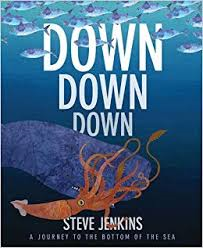
Jenkins, S. (2016). Down, down, down: A journey to the bottom of the sea. Boston, Massachusetts: Houghton Mifflin Court books for young readers; Reprint edition.
Summary: Half the earth’s surface is covered by water more than a mile deep, but most of this watery world is a mystery to us. In fact, more people have stood on the surface of the moon than have visited the deepest spot in the ocean. Come along as we travel down, down, down, from the surface to the bottom of the sea. Along the way you can see jellyfish that flash like a neon sign, creatures with teeth so big, they can’t close their mouths, and even a squid as long as a bus, which battles to the death with a sperm whale, the largest predator on earth. It’ll be a journey you won’t soon forget! Award-winning author-illustrator Steve Jenkins delivers another masterful collection of fascinating facts and amazing art. Retrieved from Amazon: https://www.amazon.com/Down-Journey-Bottom-Sea/dp/0544709519/ref=sr_1_1?crid=35B0IDJ5OSIU1&keywords=down+down+down+a+journey+to+the+bottom+of+the+sea&qid=1575415163&sprefix=down+down+down+%2Cdigital-text%2C182&sr=8-1
Age Level- Preschool-3rd grade
Justification: this would be great book to use when going over ecosystems. its important to know about the ocean considering it takes up most of the earth. They should also know about the five oceans and some of the concepts that come with each. Students should find it interesting to learn about the different animals that can be found in the ocean. Students will learn about new animals that they most likely did not know existed. I chose this book because I think students could use this book to complete a lot of cool activities with. Some activities that thought of would be students getting assigned an animal and writing a short presentation over it.
Review: ” In this intriguing introduction, Jenkins explores the Pacific, gradually descending to its depths (shown by a scale along the right hand side of each double-page spread). His signature cut-paper illustrations show more than 50 creatures, from the albatross in the air to the flatfish living at the bottom of the Mariana Trench. Along the way he introduces such oddities as a three-foot comb jelly called a Venus’s girdle, a glowing siphonophore colony and a hairy angler with her parasitic mate. Browsers will be delighted by the variety of species, shown in their appropriate colors although not to scale. Backmatter provides some information about the animals pictured, including sizes compared to a human body or hand, although the bibliography does not seem to include the sources used for those facts. Once again, Jenkins provides an almost irresistible entry into our natural world for the youngest readers. ” As stated from Kirkus Reviews : https://www.kirkusreviews.com/book-reviews/steve-jenkins/down-down-down/
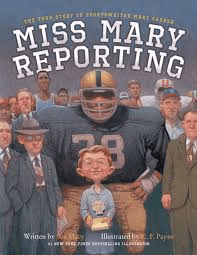
Macy, S. (2016). Miss Mary Reporting: The true story of sportswriter Mary Garber. New York: Simon and Schuster.
Summary: Mary Garber was a pioneering sports journalist in a time where women were rarely a part of the newspaper business. Women weren’t even allowed to sit in the press boxes at sporting events, so Mary was forced to sit with the coaches’ wives. But that didn’t stop her. In a time when African-American sports were not routinely covered, Mary went to the games and wrote about them. Garber was a sportswriter for fifty-six years and was the first woman to receive the Associated Press Sports Editors’ Red Smith Award, presented for major contributions in sports journalism. And now, every year the Association of Women in Sports Media presents the Mary Garber Pioneer Award in her honor to a role model for women in sports media. Sure to inspire future journalists, athletes, and any child who has a dream, this illustrated biography of Mary Garber captures her feisty and determined spirit and brings her story to life. Retrieved from Amazon: https://www.amazon.com/Miss-Mary-Reporting-Sportswriter-Garber/dp/1481401203/ref=sr_1_1?keywords=miss+mary+reporting&qid=1575416769&sr=8-1
Age Level: Kindergarten-3rd Grade
Justification: RL.2.3- describe how characters in a story respond to major events and challenges in order to make meaning of the story development. this story works with standard because it documents how Mary Garber faced the challenge of being in a male dominated field. This could help students develop an idea of character development as well as learning a lesson that they should never be afraid to do something. This book could entice both girls and boys, for girls it shows a strong female character and the book is mainly about sports which would keep boy engaged. I think this a great story and has a good lesson behind it.
Reviews: ” One of three daughters, Garber was introduced to sports by her father. She quarterbacked football with boys, created a lively family newspaper instead of writing letters to relatives, and pursued newspaper work after college. A society reporter at Winston-Salem’s Twin City Sentinel,Garber got a career break during World War II. With the male sportswriters gone, her editor assigned her the sports pages. Garber soon moved to sports for good, covering competitive contests from football to marbles. Macy’s clear, anecdotal writing is backed with solid research and documented quotations. She highlights Garber’s coverage of Jackie Robinson and demonstrates that Garber made inroads too, reporting on games at North Carolina’s segregated African-American schools. She overcame her own discriminatory roadblocks as a woman barred from press boxes and locker rooms. Macy clearly connects Garber’s determination, talent, and sense of fair play with deserved recognition: she garnered a host of awards and widespread admiration.” As cited from Kirkus Reviews: https://www.kirkusreviews.com/book-reviews/sue-macy/miss-mary-reporting/
This is an example post, originally published as part of Blogging University. Enroll in one of our ten programs, and start your blog right.
You’re going to publish a post today. Don’t worry about how your blog looks. Don’t worry if you haven’t given it a name yet, or you’re feeling overwhelmed. Just click the “New Post” button, and tell us why you’re here.
Why do this?
The post can be short or long, a personal intro to your life or a bloggy mission statement, a manifesto for the future or a simple outline of your the types of things you hope to publish.
To help you get started, here are a few questions:
You’re not locked into any of this; one of the wonderful things about blogs is how they constantly evolve as we learn, grow, and interact with one another — but it’s good to know where and why you started, and articulating your goals may just give you a few other post ideas.
Can’t think how to get started? Just write the first thing that pops into your head. Anne Lamott, author of a book on writing we love, says that you need to give yourself permission to write a “crappy first draft”. Anne makes a great point — just start writing, and worry about editing it later.
When you’re ready to publish, give your post three to five tags that describe your blog’s focus — writing, photography, fiction, parenting, food, cars, movies, sports, whatever. These tags will help others who care about your topics find you in the Reader. Make sure one of the tags is “zerotohero,” so other new bloggers can find you, too.

 Carrie Lester's Annotated Bibliography